Posted January 11, 2026 Written by Nicholas Hellmuth
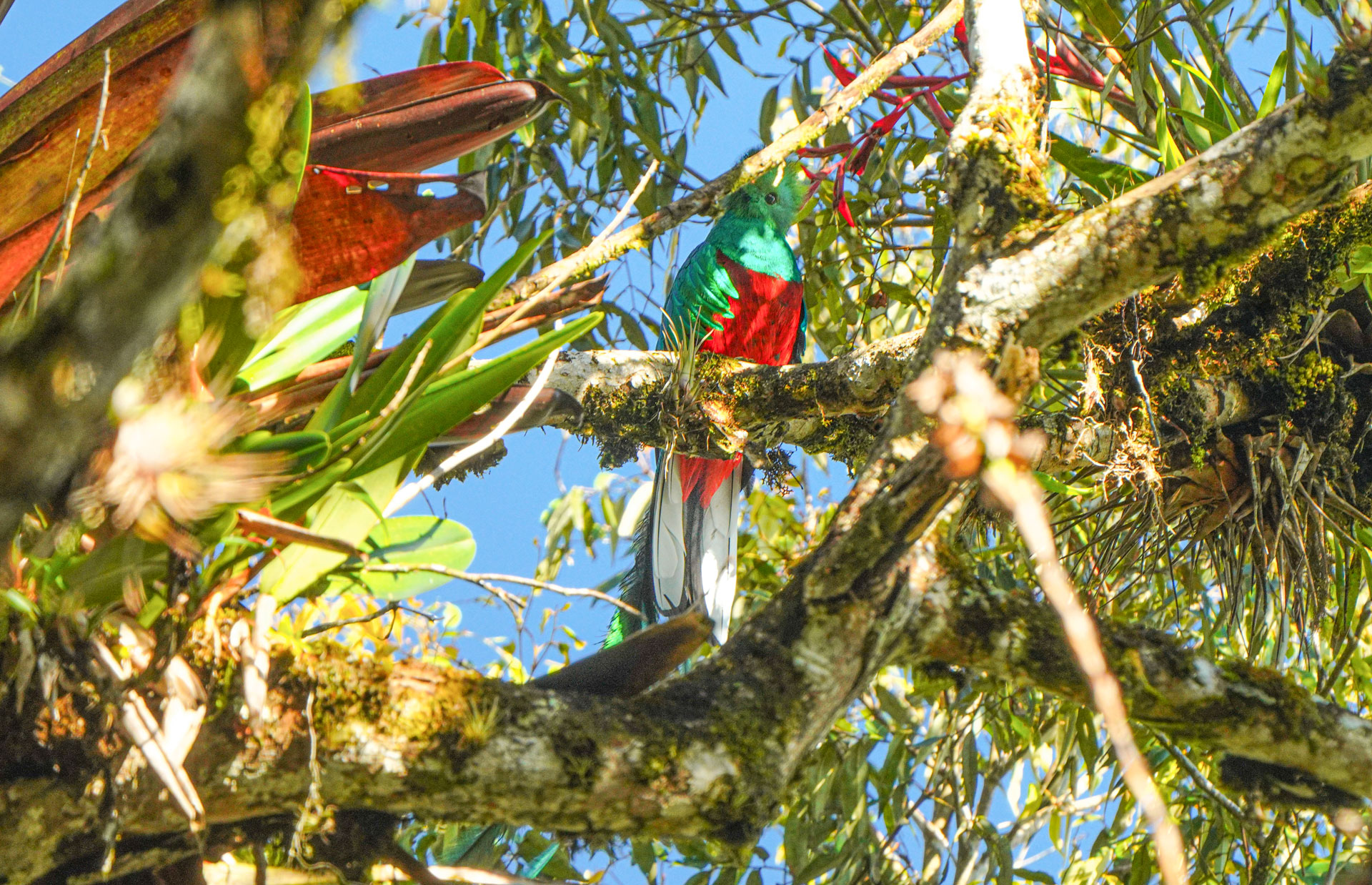
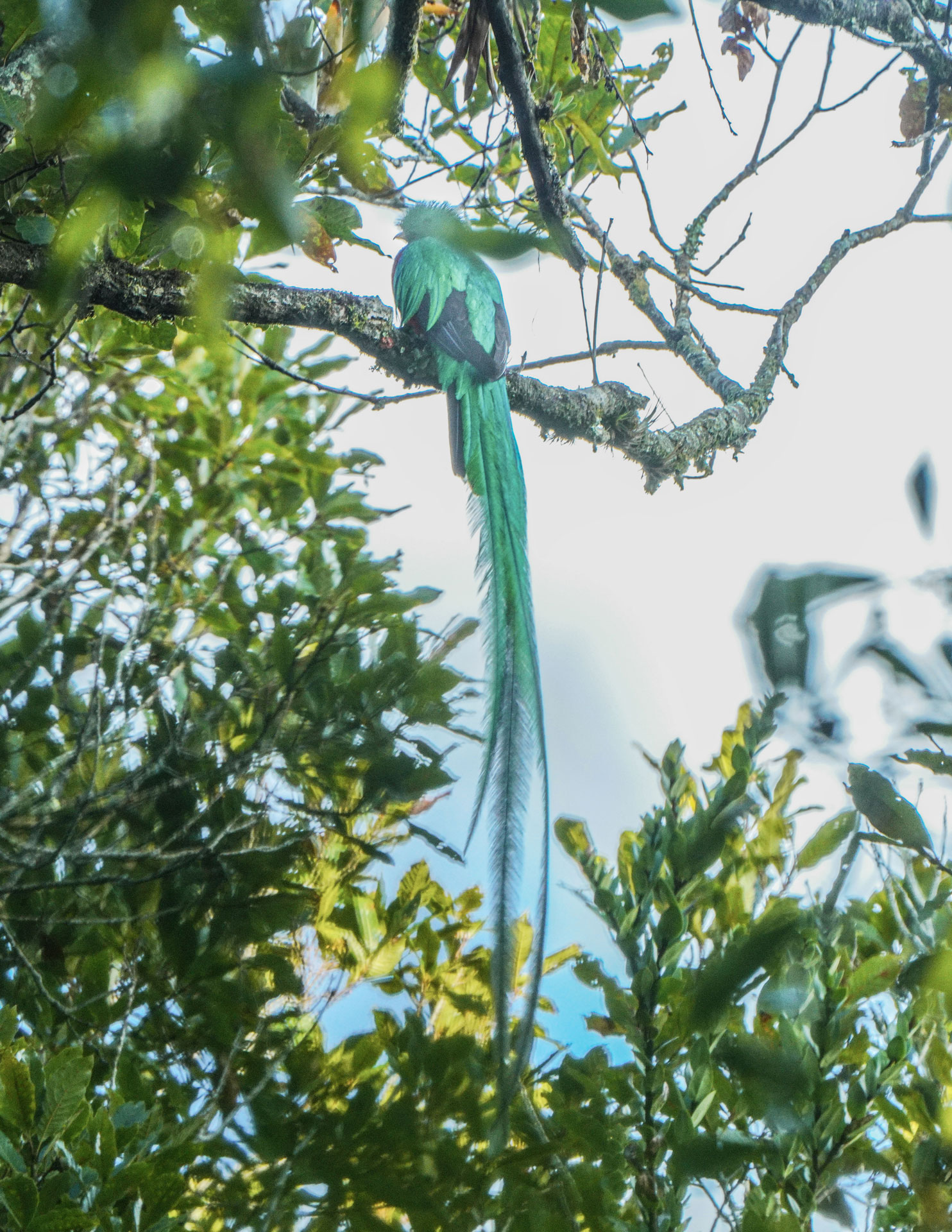
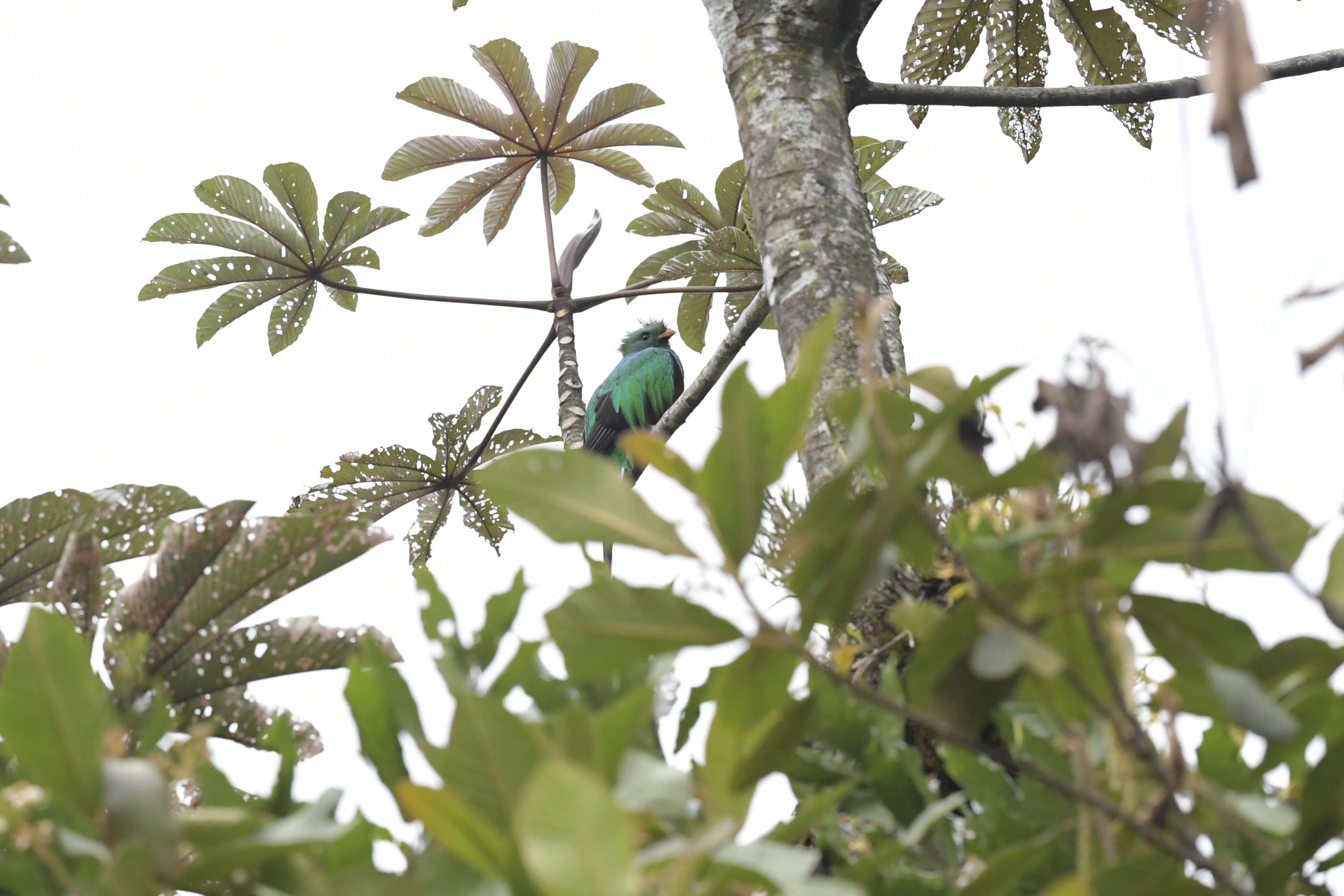
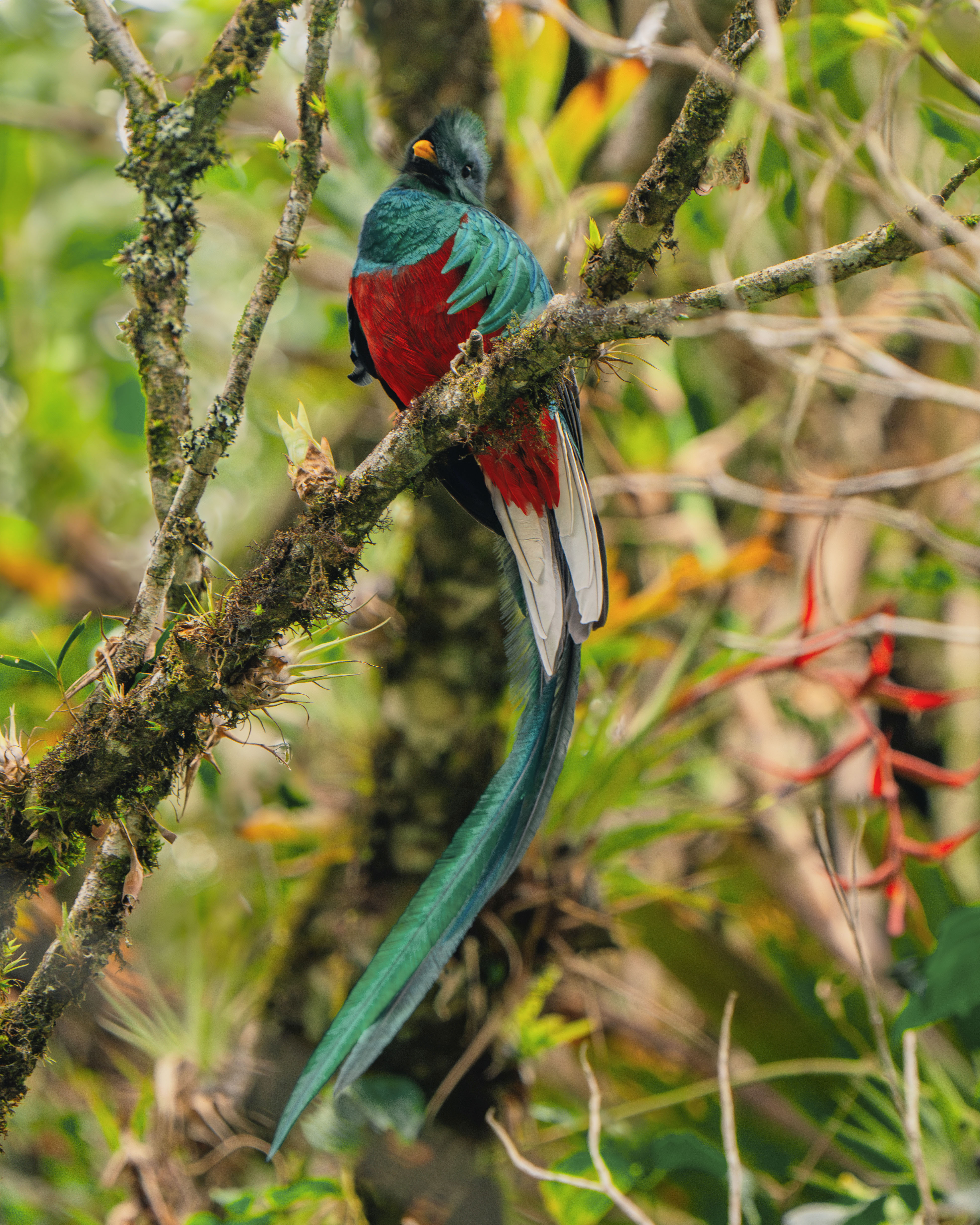
We start off the New Year (2026) with two helpful photos from Javier Archila of the resplendent quetzal, Pharomachrus mocinno, the national bird of Guatemala and a sacred bird for thousands of years. Javier photographed these birds during October 2025, at Ranchitos del Quetzal, Baja Verapaz. The FLAAR team has also stayed at this hotel in previous years to photograph the quetzales which occasionally fly to the surroundings of the hotel (so you don’t have to climb steep hills elsewhere).
We are studying all animals that are featured in Maya art, especially artifacts and textiles exhibited in the national museum of archaeology and ethnology of Guatemala to prepare educational material for students who come by the thousands to visit this museum. Many authors of the previous century captioned birds associated with Early Classic incensarios as “quetzal” but by studying quetzales we realize that although this sacred quetzal bird is present in Maya artifacts—and lots in Maya weaving of today—the bird that is on incensarios is an owl. The other more common creature on these Early Classic incense burners has long been recognized correctly as a butterfly.
So we have a lot to study during 2026—how many different species of butterfly, or moth, are on incense burners. Most writers call it the black witch moth—but if you look at the dozens, scores of butterflies on the endless numbers of incense burner lids you see that many different species are pictured and I estimate a lot are butterflies—not a black witch month.
Another challenge is to learn how many different species or regional variants of pre-Hispanic dogs appear in Maya art. I estimate at least three different sizes, shapes and fur patterns were present (but I may revise or expand this estimate after more research).
Jaguars have been a research topic for decades, and we have learned that lots of the feline pelage designs on Maya ceramics are NOT jaguar—but are patterns of ocelot, Leopardus paradlis.
We have been studied insects in Maya art for the recent three years since most captions for scenes of Late Classic insects just dump them as “bee” which is 90% of the time incorrect. More than half the insects in Maya art have not yet been named correctly. So a lot more research.
I have been studying waterbirds since research in the 1980’s for my 1986 PhD dissertation (published in 1987), and we continue this research. We will be documenting a lot of advances later in 2026.
Horizontal view, photo by Javier Archilla, processed in Camera RAW.
Posted December 24, 2025 Written by Nicholas Hellmuth
This is "Santa Nicholas" being pulled by native deer of Guatemala. The same species of deer that are common throughout the USA are also native and wild even in the rain forests of Guatemala. In Classic Maya art deer are often associated with monkeys—some Maya portraits of deer feature an obvious monkey tail on the deer. And paintings of monkeys often show them with deer antlers and deer ears.
The circular path is the Maya Sky Band with celestial motifs. We have published many PDFs on this topic. Just Google Sky Band Hellmuth FLAAR.
Often the Sky Band is the body of a Bicephalic Cosmic Monster, with "starry-eyed" deer at the left and an upside-down Quadripartite Badge Headdress monster at the right. Just Google Bicephalic Cosmic Monster, crocodile lecture, Hellmuth and you will see lots of Maya art with this cosmic monster.
For year 2026 we will continue with new iconography reports on deer, on monkeys, on bats, on rabbits, on macaws and fish and other native fauna featured in Maya art at the national museum of art and ethnology of Guatemala. The goal is to prepare educational material for the literally hundreds of school groups that visit the museum every month plus the thousands of tourists who also visit this prestigious national museum.
Simultaneously, we will be engaged in field trips and library research on flora, fauna and biodiverse ecosystems of the Reserva de la Biosfera Maya, RBM, Peten, especially of Parque Nacional Yaxha, Nakum and Naranjo (PNYNN) and surroundings.
We now have a new Mavic 4 Pro drone whose aerial camera is significantly better than all previous models that we had in recent years. Most importantly for working in national parks, the Mavic 4 Pro can be flown at eye-level through the forest—so we can show eye-level views in addition to the obviously important aerial views from above.
We also continue our long-range research project on all the hundreds of wild plants, native to Guatemala, have edible parts. With the help of the Q’eqchi’ Maya team that work with us, we are preparing FLAAR Reports on several wild plants of the cloud forests of Alta Verapaz that produce edible food without needing slash-and-burn milpa agriculture.
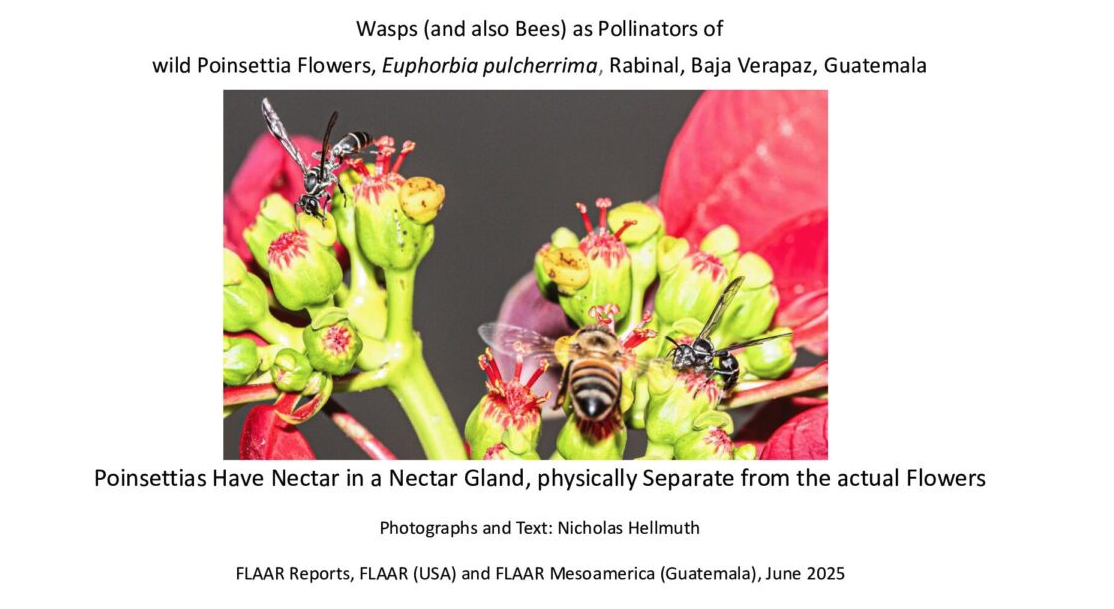
Wasps (and also Bees) as Pollinators of
wild Poinsettia Flowers, Euphorbia pulcherrima, Rabinal, Baja Verapaz, Guatemala
Poinsettias Have Nectar in a Nectar Gland, physically Separate from the actual Flowers
Beetles, flies, moths in addition to butterflies, bats are also pollinators. I have seen ants wandering across flowers and leaving with pollen attached to their body. Same with grasshoppers (in the FLAAR Ethnobotanical Research Garden in Guatemala City). Obviously botanists and wasp entomologists know that wasps are also pollinators, but the general public tend to detest wasps to such a degree that they don’t consider them beneficial in any aspect.
All the wasp species that have made nests in front of my door have never attacked me even when I was doing close-up macro photography—because these wasps saw me every day and realized that I never bothered their nest.
Yes, there are vicious WARRIOR WASPS, including in Guatemala, the Northern Warrior Wasp, but if you don’t get too close to their nest they will not attack. We have photographed lots of their nests with telephoto lenses and now have a FLAAR Reports on them.
Deer Iconography in Classic Maya Art Part 1, Just Deer, No Hunting Scenes, 75 pages with 65 photos and drawings.
Deer in Maya Art, Iconography Part II, Deer in Kerr Rollouts and Deer in Hellmuth Digital Rollouts, Rollout Drawings from FLAAR Illustrators and Rollout Drawings by Dana G. Moot II, 193 double-width pages with 192 rollouts, photos, and drawings.
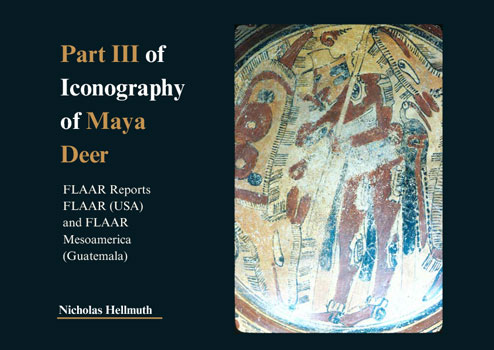
Deer Hunters’ Headdresses and Conch Shell Musical Instruments The same Hunters’ Headdresses were worn by many Maya Ballplayers, Part III of Iconography of Maya Deer. 121 double-width pages with over 159 rollouts, photos, and drawings.
Deer Hunting Hats worn as Headdresses by Maya Ballplayers, Iconography of Maya Deer, Part IV. 51 pages with 28 photos, including rollouts, drawings, and rollout drawings.
440 pages of text including 372 rollout photos, rollout drawings, plus photos and drawings in addition to the rollouts. So, if you are curious about deer in Maya iconography this series is available to you. We greatly appreciate the illustrations that were sent to us by archaeologists and iconographers—they are all credited in the captions. Illustrations from books and articles are cited in the captions.
This corpus of illustrations makes it possible to share documentation on the iconography of deer in Classic Maya art.
This is "Santa Nicholas" being pulled by native deer of Guatemala. In Classic Maya art deer are associated with monkeys. And paintings of monkeys often show them with deer antlers and deer ears.
The circular path is the Maya Sky Band with celestial motifs. We have published many PDFs on this topic. Just Google Sky Band Hellmuth FLAAR.
Often the Sky Band is the body of a Bicephalic Cosmic Monster, with "starry-eyed" deer at the left and an upside-down Quadripartite Badge Headdress monster at the right. Just Google Bicephalic Cosmic Monster, crocodile lecture, Hellmuth and you will see lots of Maya art with this monster.
So for year 2025 we will continue with new iconography reports on deer, on monkeys, on bats, on rabbits in Maya art. Our research results on iconography of peccary in Maya art are already published--just Google peccary, Maya iconography, Hellmuth.
Written by researchers Sergio D’angelo Jerez and Alejandra Valenzuela.
Edited by Sergio D’angelo Jerez.
On September 5, 2024
In commemoration of National Quetzal Day in Guatemala, we encourage you to learn about the national bird of this country, but in a different way. Here you will find an extract from The bird-snake mansion, one of the most beloved literary works in Guatemala, written by Guatemalan author Virgilio Rodríguez Macal. In correlation with different paragraphs of the extract, you will also find scientific data related to real-life elements described by Rodríguez in his tale.
Habitat and distribution
Now, another inhabitant of the rooms of Jorón, the cold,
was Gug, the Resplendent Quetzal…truly, he was the most beautiful of all, the most
beautiful among all those who move
around
the vast extensions of the Green World…
A male Resplendent Quetzal photographed in Ranchitos del Quetzal. Purulhá, Alta Verapaz; June 15, 2017. Photo by Nicholas Hellmuth.
Pharomachrus mocinno, also known as the Resplendent Quetzal, is truly a beautiful bird endemic to Mesoamerica. Its most usual habitats are patches of high-elevation tropical, rainforests and cloud forests in the geographical region that ranges from Chiapas, in Southern México, throughout Central America, and Panama (Renner, 2005). This magnificent bird is usually found at elevations exceeding 1,400 masl, often in very humid forests with abundant broad-leaved oaks (from the Quercus genus), pines (Pinus spp.), and other evergreen tree species (Kappelle, 2006). Studies have found that P. mocinno prefers to inhabit primary forests (forests that have been not disturbed by human activity), and that it is also able to survive and reproduce in some secondary forests (forests that develop after having cleared the original primary forest) (Chokkaingam, 2001; Renner, 2005).
Characteristics
He was known by the name Gug, the snake-bird, since he truly looked like a cute little bird who was always followed by two or more snakes of the most beautiful colors… Gug’s chest was red as blood, with a little white. His body had an unidentifiable color, between blue, gold, and green, as if the rainbow itself lived on him forever, broken into a thousand pieces.
Divine, most truly, was the bird-snake, since these snakes that followed him were no other than Gug’s tail, a tail with three or even more of the longest feathers, that looked each as a thin rainbow…
When Gug moved around the ground, the leaves, and ferns shook behind his body, as the feathers of its tail went through. True divine snakes are what the feathers of its tail looked like, which followed him submissively as if they were snakes of Heaven, with no poison, and with no evil.
A beautiful male Resplendent Quetzal. Photo shared by Haniel López.
Although the Resplendent Quetzal is famous for what its name describes, a sumptuous bird of iridescent emerald colors, this description doesn’t fit all the members of the species. As can be observed in many instances in nature, P. mocinno presents an evident sexual dimorphism in adults, a condition where males and females from the same species have different appearances (Britannica, 2024; Dayer, 2020). Adult males have long and green uppertail covert feathers that grow beyond the tail, as well as small feathers on the head that form a crest, and bright yellow beaks. This, along with the iridescent gold and green feathers that cover most of its body and the bright red feathers of its belly and undertail covert, are the most distinctive features of a male Quetzal.
The female’s appearance is a bit less eye-catching; the feathers on its belly, throat and sides are grayish brown and their beaks are dark gray. Females also have a crest and uppertail coverts, but these are much smaller and less developed than in males. Nevertheless, females have the same beautiful golden-green feathers on body areas like the crown, back, wings and uppertail coverts (although they do not grow beyond the tip of its tail) (Dayer, 2020).