
In the Maya area of Guatemala, Belize, Honduras, and Mexico you can find both crocodiles and (relatives of) alligators.
- Crocodylus moreletii, Morelet's Crocodile
- Crocodylus acutus, American Crocodile
- Caiman crocodiles, Spectacled Caiman, is a relative of alligators
Crocodylus acutus can be found from the USA south through Mexico and Guatemala, so would have been known to many Mesoamerican cultures.
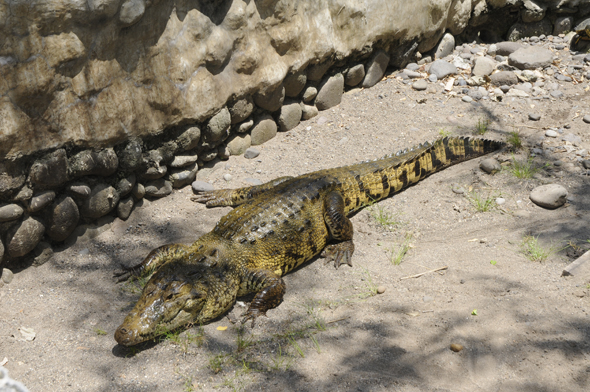
Crocodylus acutus taking sun in Autosafari Chapin during a field trip in Guatemala. FLAAR photo archive, Guatemala, Guatemala.
Crocodylus moreletii has fewer bumps and "spines" than others. The one in the Guatemala City zoo was more aggressive than other species. Habitat is only in the Mexico, Belize, Guatemala area, so much more limited than other species. Nonetheless, Crocodylus moreletii would have been featured by Maya of Peten, since this crocodile likes rivers and lakes of the Maya Lowlands.
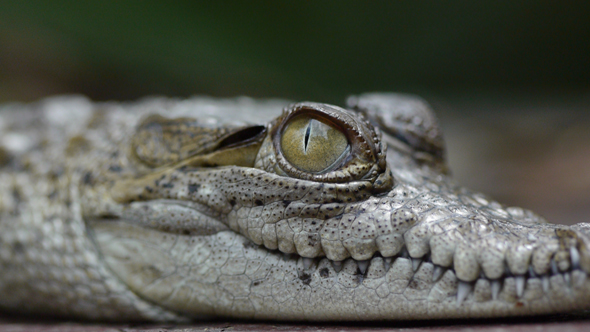
A young Crocodylus moreletti at Aurora National Zoo. Photo by Gustavo Gallegos, July 2011, Guatemala City.
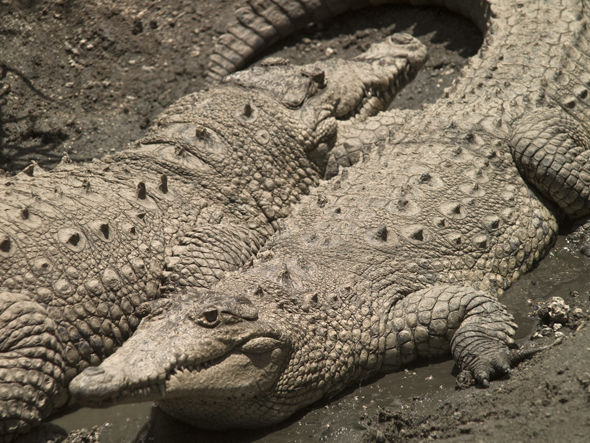
Crocodylus morelettii adults in Aurora National Zoo. Photo by Nicholas Hellmuth, July 2009, Guatemala City.
Caiman crocodilus is a caiman but is in the Alligatoridae family (so is not a crocodile despite its name "crocodilus"). Best to call it a caiman (and not to call it an alligator).
Cocodrilo in local Spanish means crocodile or its relatives. Lagarto (lizard) is actually the word used for crocodile in remote areas. The many trees of Guatemala that are named palo de lagarto are so named because their bark pattern and/or spines remind people of the back of a crocodile. I doubt a palo de lagarto is a “Lizard Tree.” It is a “CROCODILE Tree”.
Caiman tends to mean alligator but can refer to other crocodilians, especially if the precise species is not known by the person talking.
Crocodiles in the Popol Vuh
You can learn about crocodiles in the myths of the Popol Vuh.
Crocodiles in the stone sculpture of Copan, Honduras
Stela C (CPN 4) at Copan clearly shows the top of the entire head with snout and teeth of a crocodile. Also at Copan there are several 3-dimensional sculptures that have traditionally been considered as stylized crocodiles. More crocodilians are pictured at Copan than at any other Classic Maya site.
Many mythical creatures are a mixture of snake and crocodile (and even deer features). Altar G1 (CPN 13) is an example. This is called the Cosmic Monster; earlier archaeologists and iconographers called it the Bicephalic Monster.
Copan Altar T (CPN 13) has one clearly featured crocodilian (figure facing to the right); and another which is of unclear species (facing left). That snout is too short to be a crocodile and even rather short to be a caiman. There are also Gila-like monsters nearby in the Motagua River area that have plenty of healthy looking teeth. Plus many mythical monsters in Maya art are a concoction of trance-induced delusions (so are not always naturalistic).
Crocodile sculptures along the Rio Usumacinta: Piedras Negras and Yaxchilan
At Piedras Negras the substantial natural rock outcrop that overlooks the Rio Usumacinta is in the form of a large saurian creature at impressive size. At Yaxchilan there is a long crocodile sculpture on the ground.
Crocodile remains found in royal Maya burials
Burial 10 at Tikal included the remains of a crocodile, and turtles. The King of Tikal even had the name Crocodile. If you checked the contents of all other Early Classic Maya burials surely you would encounter other remains of reptiles.
Crocodile monsters as ceramic figurines
Louise Belanger, illustrator for the Lamanai Archaeological Project, Belize, has done many drawings of crocodilian figurines from the Maya site of Lamanai. This Maya city is next to a river that would have been filled with crocodiles a thousand years ago (rivers in Belize still have crocodiles today). Indeed the name of the site is considered to mean "Submerged Crocodile." cbelanger[-at-]blueyonder.co.uk
Crocodiles mentioned by Spanish Andres de Avendaño
In his diary of his escape from being barbequed by the Peten Ytza Maya in the 17th century, Spanish priest de Avendaño says that as he was escaping after he got lost in the jungles en route to Belize and Yucatan, he noticed that the ground under him was moving. He looked down and found out that he was walking on the backs of a mass of crocodiles (evidently too sleepy or too dormant to eat him). This diary by Andres de Avendaño is one of the most informative books on Post Classic Maya culture that exists.
Crocodiles eating tourists or local people: Tikal and Lake Yaxha
The crocodilian in the aguada at Tikal attacked many local people. You can get the gruesome facts on the Internet. One crocodile wounded a Dutch tourist at Lake Yaxha park. The reptile was eventually shot (its skull is in the lake-side hotel). But I lived on the shore of Lake Yaxha for four years in the 1970’s (while mapping Yaxha and surrounding areas). Plus FLAAR (USA) and FLAAR Mesoamerica (Guatemala) have been doing flora, fauna and wetlands ecosystem field work around Lake Yaxha from 2019 and continuing today in 2023: none of us have been attacked by crocodiles at Yaxha). Nor at Tikal.
Crocodiles are very fast, and they can jump up higher than you would guess (I know, since I had one in my house in Zone 10). It was wounded by a gig (fishing spear) by a local person in Peten and I brought it back on the airplane to have it treated by a vet in Guatemala City. During the flight back it got out of its basket and wandered around under everyone's seat.
Fortunately this was in the 1970's, and airlines did not pay too much attention to this sort of thing on local flights in those days. I made a pool in my house and kept him for a few years and then donated him (or her) to the zoo. He was fully healed by then.
I do not recommend crocodiles as pets. First, they are not very appreciative; second, they are not easy to train. Third, when guests come over and say, "oh, how cute, you have a pet crocodile." They tend to want to pet the crocodile which the crocodile appreciates: it sees a piece of fresh meat being aimed directly at its head.
I never figured out how anyone with a brain could calculate that a crocodile would appreciate being rubbed behind the ears (or anywhere). With their scales I doubt they would feel much tender loving care.
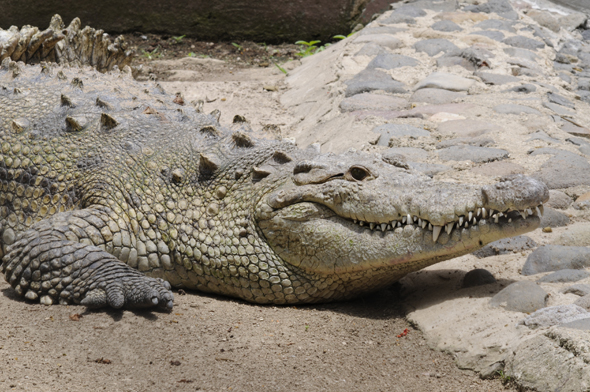
Crocodylus morelettii adults in Aurora National Zoo. Photo by Nicholas Hellmuth, July 2009, Guatemala City.
Crocodile tree and the World Tree (Ceiba)
The pre-Classic stelae of Izapa (Chiapas, Mexico) are the main source of the crocodile tree, but as I illustrate in my PhD dissertation, there are also several crocodile trees in Early Classic and Late Classic Maya art of Peten, Guatemala. Almost all of the identifications of these trees on Izapa sculptures are incorrect. One of the trees is clearly a Crescentia species, morro or jicaro (which ironically is not a palo de lagarto and has no crocodilian bark pattern). The other crocodile trees on other Izapa stelae (and on later Peten-area Maya pottery) are different species.
Crocodile as a "crocodile canoe"
The Dallas Museum of Fine Art labels their eccentric flint (1983.45.McD) as a "crocodile canoe with passengers". This is a fabulous work of art. In theory, you won't get any forgery with this much exquisite detail. But there is a person who can reproduce, today, any complexity and any style of chert or flint. I can't remember the web site, but it shows all this remarkable work. Although I assume the artifact in the Dallas museum is probably pre-Columbian, after seeing the work of this person I would be hesitant on some other eccentric flints in a private collection.
The two-headed cosmological monster, usually considered a sky creature, and assumed sometimes to be a snake, often has a body of the proportions of a crocodile rather than of a snake. Plus a snake does not have humanoid limbs and especially not limbs like a crocodile.
Crocodiles in the Maya codices
(Tozzer and Allen 1910: Plate 13)
10. Head of crocodile, Dresden 52b.
12. Conventionalized head of a crocodile, Dresden 53b.
Crocodiles are common also in the art of other Mesoamerican cultures
Nuttall 1, 4, 9, 36, 47, and 75, pictured by (Tozzer and Allen 1910)
Where to find crocodiles, caimanes and alligators in Guatemala
The main La Aurora zoo near the airport has all three species. One of these beasts may even be one that I donated several decades ago.
Auto Safari Chapin has additional crocodilians on exhibit. CECON in Monterrico also has at least two species on exhibit, especially the local caiman. Each of these locations were considerate in providing permission to photograph these impressive reptiles.
One species of crocodile is in the aguada at Tikal but I rarely see it. There are crocodiles or caimans still on the shores of most of the rivers and lakes throughout Peten, but you need to be patient, and most of the reptiles are not very large.
Thesis or dissertation on crocodiles in Belize, Honduras, Mexico, Guatemala
For students interested in Maya iconography, or ethnozoology, it would be good to have a thesis or dissertation on crocodiles, especially if you are really good in rendering inked line drawings of the scale patterns.
The other advantage of a thesis or dissertation on crocodiles is that you would also be exposed to ethnobotany as well, since the crocodile tree takes you into the iconography and botany of several species of trees. FLAAR has been doing research on the palo de lagarto now for about five years. We have an abundant photo archive.

BOOKS ON CROCODILES
We include a longer bibliography in our forthcoming pages on caiman and both species of crocodiles during the summer (2023). There is also a bibliography in our monograph on Maya ethnozoology. But here are five books to start with:
- 1974
- Los Crocodylia de Mexico. Instituto Mexicano de Recursos Naturales Renovables.
Miguel Alvarez del Toro, was the leading zoologist of the Chiapas area of Mexico. His book covers primarily the Mexican aspect of this reptile. - 2001
- Geographic variation in Caiman crocodilus and Caiman yacare (Crocodylia: Alligatoridae): Systematic and legal implications. September 2001, Herpetologica 57(3):294-312.
Helpful download from ResearchGate. - 1998
- Amphibians and Reptiles of Northern Guatemala, the Yucatan, and Belize. University of Oklahoma Press. 400 pages.
- 2006
- Crocodile: Evolution's Greatest Survivor. Allen & Unwin. 288 pages.
Although not focused on Mesoamerica, this book can get you started on crocodiles around the world. - 2000
- A Field Guide to the Amphibians and Reptiles of the Maya World: The Lowlands of Mexico, Northern Guatemala, and Belize. Cornell University Press.
- We will be publishing an entire bibliography for the July 2023 lecture by Nicholas Hellmuth on iconography of crocodiles in the art of the Maya and Olmec. Here is just four of what is to come:
- 2004
- El cocodrilo en la cosmovisión Maya: Un proceso de larga duración. B.A. thesis, Ethnohistory Area, Escuela Nacional de Antropología e Historia, Instituto Nacional de Antropología e Historia, Secretaría de Educación Pública.
- 1994
- Maya Sculpture of Copan: The Iconography. University of Oklahoma Press. 300 pages.
There are more crocodiles and crocodile-composite monsters in the monumental stone sculpture of Copan than any other site. This is curious since Yaxchilan, Piedras Negras, El Peru, and dozens of other Classic Mayan sites are also on major rivers which were full of crocodiles. Plus there are Crocodylus acutus in coastal swamps in Belize and elsewhere. - 2010
- Fiery Pool: The Maya and the Mythic Sea. Yale University Press, New Haven.
- 2001
- "Compendio de monumentos expuestos en Tak'alik Ab'aj" (versión digital). XIV Simposio de Investigaciones Arqueológicas en Guatemala, 2000 (edited by J.P. Laporte, A.C. Suasnávar y B. Arroyo) (Guatemala: Museo Nacional de Arqueología y Etnología): 786-806. Retrieved 2009/02/01. (Spanish)
Web page on Crocodiles, Alligators or Caimans
www.famsi.org/reports/03101/02vargas_arias/02vargas_arias.pdf
THE CROCODILE AND THE COSMOS: ITZAMKANAC, THE PLACE OF THE ALLIGATOR'S HOUSE
Ernesto Vargas Pacheco Teri Arias Ortiz. The use of the word alligator is a typical result of Spanish language using informal terms such as lagarto. Itzamna is either a crocodile, or a caiman. Unless it is a composite he can't be both. And there is a 66% chance he is a crocodile and only 33% chance he is a caiman (which in theory would make it allowed perhaps to be called, informally, an alligator).
www.newsweek.com/mystery-ancient-maya-city-looks-like-crocodile-1759025
The Mystery of the Ancient Maya City That Looks Like a Crocodile, by Aristos Georgiou, 2022.
Most Recently Updated May 31, 2023
Previously Improved on June 26, 2012 and January 25, 2018
First Posted November 4, 2011