
Where to find vultures to do photography and take notes
Most bird watching groups are probably seeking other bird species, but as an archaeologist I find the vultures both beautiful works of nature, and quite important as models for the vultures seen in ancient art of pre-Hispanic Mesoamerica.
You can see vultures most easily alongside most highways. The vultures are attracted to road kill. You can also see vultures alongside the rivers in Peten, such as the Rio de la Pasion or Arroyo Petexbatun: eating fish or other dead creatures alongside the river banks. In any city with a dump, you can find vultures at the dump.
I almost never see a King Vulture any more. The other vultures are more common, especially the black vulture.

Black vulture, Coragyps atratus perching on a tree at Río de La Pasion, Sayaxche, Pete, Guatemala. Photo by Jennifer Lara, December 2010.
If you need to see all the vulture species, you may need to try one of the large zoos, such as Miguel Alvarez del Toro Zoo (ZOOMAT) in Tuxtla Gutierrez, Chiapas, Mexico. You might also try the Belize zoo, and the city zoo, Parque Zoológico La Aurora, in Guatemala City.
Vultures in Guatemala, Belize, and Guatemala
- Turkey vulture, Cathartes aura
- Black vulture,Coragyps atratus
- Lesser yellow-headed vulture, Cathartes burrovianus
- King Vulture, Sarcoramphus papa
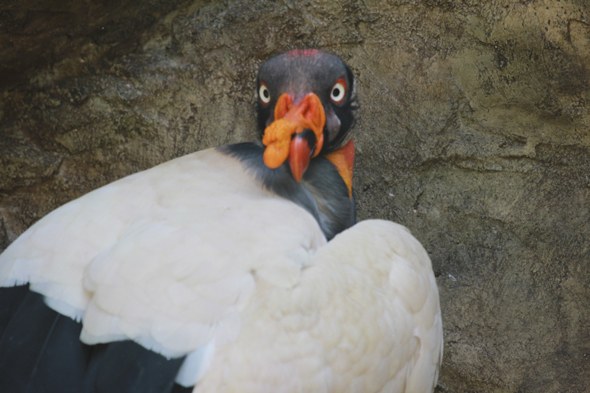
King vulture, Sarcoramphus papa, at La Aurora National Zoo. Photo by Sofia Monzon, September 2011
Elizabeth Benson has written on the iconography of vultures
Elizabeth Benson lists most of the Classic period vases which picture vultures and Mayan myths which feature vultures. But I am not convinced that all the birds on the vases are really vultures. For example, it is highly unlikely that the long-beaked birds of Kerr 2668 are vultures. Besides, the human in the scene is wearing the hat of a hunter. I would expect water birds in such a scene; not vultures.
Vultures are found as hachas since vultures are part of the ballgame
Evidently in some pre-Columbian rubber ball games the sacrificed victims were made available to vultures. So it is not much of a surprise that some ballgame stones are shaped as a vulture.
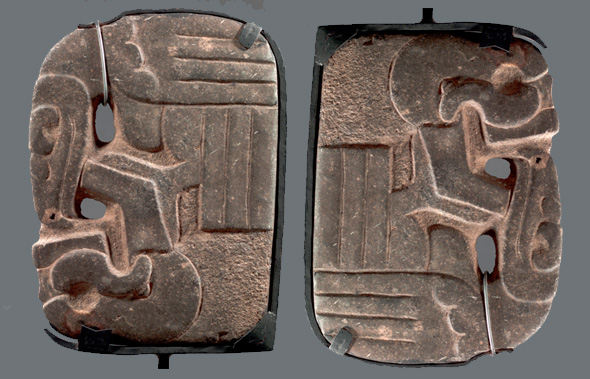
Here a culture is picking the last bit of flesh off a human skull. We show the hacha rightside up so you can see the vulture; and upside down so you can see the skull.
Vultures are frequently depicted in Mayan hieroglyphic writing
Epigraphers correctly point out the vultures used as hieroglyphs. Because there are four species of vultures, and several different Mayan hieroglyps which are based on vultures, it would be a helpful study to see if you can identify which species is used as a model for which hieroglyph.
For turtle glyphs, owl glyphs, and bat glyphs it is a challenge to recognize which species is intended, especially when there are a few misidentifications stuck in the literature. But to help these studies it helps to have close-up photographs of the facial features of each species.
Thus a long-term goal of the FLAAR program of Maya ethnozoology, is to find funding to obtain the 500mm Canon telephoto lenses necessary to capture a close-up of the heads.
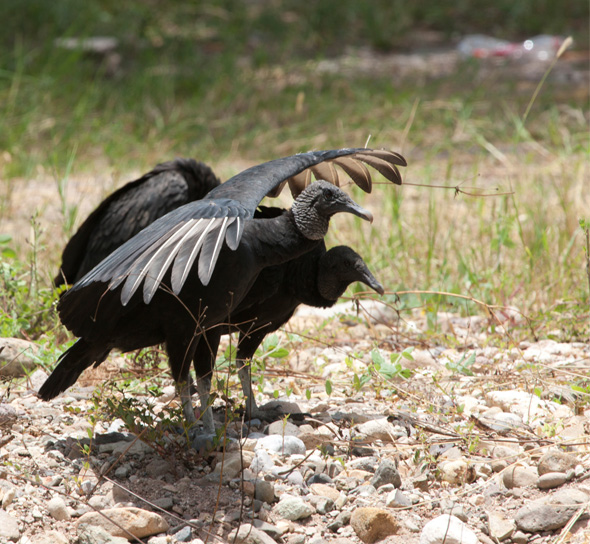
Presently we still lack a 500mm prime lens, since a high-quality Canon EF 500mm f/4L IS II USM lens is about $10,400 (the new lens that was announced early in 2011). As soon as it is possible to have this lens, we can provide epigraphers even better photographs. In the meantime, here are the best photos (of heads)
First posted November 2, 2011